I recently finished reading Love, Fiercely, a wonderful new book by Jean Zimmerman, that is aptly subtitled “A Gilded Age Romance,” as I instantly fell in love with its remarkable protagonists and their families. Having focused, professionally and personally, on New York history for so many years, I was delighted to see a new book about Isaac Newton Phelps Stokes, the man behind The Iconography of Manhattan Island and his wife, Edith Phelps Stokes, nee Minturn. Newton Phelps Stokes’ six-volume oeuvre, arguably the most important body of work on New York City, is a sweeping graphic and historic documentation of the city’s heritage. Edith Phelps Stokes spearheaded the establishment of kindergarten education and legal adoption procedures—neither of which existed in her time. Read the rest of this entry »
Central Park: An Anthology
Edited by Andrew Blauner
Paperback, 240 pages
Bloomsbury, USA, $16.00
This vibrant tapestry presents Central Park in all its glory–an ode to a unique and sacred place, universally beloved throughout the City, the country, and the world. With contributions by: Paul Auster, Susan Cheever, Jonathan Safran Foer, Adam Gopnik, Francine Prose, and others. A portion of the proceeds will be donated to the Central Park Conservancy.
The Gods of Gotham
By Lindsay Faye
Hardcover, 432 pages
Amy Einhorn/Putnam, $25.95
The Gods of Gotham takes readers back to New York City circa 1845 with a riveting story where two culture-shaping events converge: the formation of New York’s first police force and the great influx of Irish immigrants during the great potato famine. Faye draws on meticulous research and masterful storytelling talents as she recreates a time and place where many city dwellers lived in desperate and miserable conditions.
Love, Fiercely: A Gilded Age Romance
By Jean Zimmerman
Hardcover, 336 pages
Houghton Mifflin Harcourt, $26.00
“Demonstrating the same flare as in her previous biography, Zimmerman (The Women of the House: How a Colonial She-Merchant Built a Mansion, a Fortune, and a Dynasty) pays respect to the lives and times of Edith Minturn Stokes and Isaac Newton Phelps Stokes. …With an impressive amount of research behind every page, Zimmerman manages to capture the sweeping drama of the turn of the century as well as the compelling story of a couple who knew how to love, fiercely. Her superb pacing and gripping narrative will appeal to all who enjoy history, biography, and real-life romance.”—Library Journal
Tags: 19th century New York, Central Park, New York books, New York History, NYPD
Seymour Durst, a major New York City real estate developer, left the city more than steel and glass. Durst, who died in 1995, assembled what is surely the most inclusive and quirky private repository of New York books, ephemera and illustrated material, and with characteristic humor, named it Old York Library. The Durst family donated the Old York collection to the City University of New York Graduate Center in 2000. At present, it is being relocated to The Columbia University Libraries’ Avery Architectural & Fine Arts Library where it will be processed, digitized and made available to scholars in the near future.
Mr. Durst did not consider himself a collector, and his interests defy pigeonholing. His avid interest in early American history, the Revolutionary War, and Alexander Hamilton is evident, but he enjoyed his acquisitions whether it was an 1893 promotional piece for developing Harlem or the first edition of Thomas Paine’s Common Sense. Along with books of every relevant topic, era and size (from miniature to elephant folio and from the sixteenth century through the 1990’s), his collection contains scores of maps, real estate prospectuses and surveys, pamphlets on every subject (from eighteenth century merchants’ complaints on tariffs to sensational nineteenth century murder trials), rare eighteenth century almanacs, early-twentieth century advertisements, postcards, photographs, theater posters, song sheets, and atlases, and even a copy of Anderson’s Isometric Map of New York (1980). Read the rest of this entry »
Tags: Avery Architectural & Fine Arts Library, Columbia University Libraries, National Debt Clock, New York real estate, Old York Library, Seymour Durst
The other day I was listening to the Leonard Lopate Show, and he did a segment on “The Story of New York in Ten Objects,” inspired by the BBC series “A History of the World in 100 Objects.“ He asked listeners to nominate items that tell the story of New York City and then to vote for the top ten. There were many interesting submissions, and the list included some predictable and some unexpected and unusual things, from the subway token to Manhattan Schist, the material of New York City bedrock. Read the rest of this entry »
Tags: Frank O'Hara, Gus Powell, lunch, Lunch Hour NYC, New York City, New York food, photography, poetry
Moving day, also known as “rent day,” was a crazy New York City tradition from its early years until as late as World War II. Each year in the beginning of February, landlords would inform tenants of their new rent rates, which would go into effect at 9:00 AM on May 1 of that year. If the tenants could not afford their new rents, they would have between February 1 and May 1 to find a new apartment and move. In some years, up to a million households waited until the very last minute, perhaps to take advantage of their old rent rate for as long as possible, to move, causing chaos in the streets of New York. Read the rest of this entry »
Tags: 19th century New York, May 1, moving day, New York City history

The Uni at the New Amsterdam Market on September 11, 2011. The Uni will be at Sara D. Roosevelt Park in Chinatown on Saturday, April 28 from 11 am until 2 pm as part of Jumpstart's Read-a-Palooza! event.
During what appears to be an epidemic of library closings in New York City, it is comforting to know that there is at least one grassroots movement trying to provide an antidote. At the center of The Uni Project, which launched this past September 11 at the New Amsterdam Market on South Street, is a portable reading room that will be installed in parks, plazas, farmers’ markets, and other available outdoor spaces in New York City. Its purpose is to share books, showcase the act of learning, and improve public space. It is intended to be a new resource for the city, providing residents with a place to gather and contribute to their own well-being and advancement, as well as that of their neighborhood and city. Read the rest of this entry »
Tags: Leslie Davol, libraries, Sam Davol, The Uni Project
In honor of National Women’s History Month (March) and National Poetry Month (April), as well as national hat day (January 15), I would like to celebrate a New York poem written by Mary Eliza Tucker about a bridge spanning Broadway that was built for one mad hatter and torn down for another.
At one time there was some debate over whether or not Mary Eliza Tucker was of mixed Caucasian and African-American ancestry, as her work was included in collections of African-American literature, perhaps because her name is similar to that of another poet. Indeed, in the link to the poem on the New York Public Library’s site below states that the poem was “[p]repared as part of The Digital Schomburg, a project providing electronic access to collections on the African Diaspora and Africa from The New York Public Library.” It has since been established by Janet Gray, in her 1998 article in Representations, that Tucker was a white woman who lived for some time in the South before she worked in New York as a writer. Read the rest of this entry »
Tags: 19th century New York, Loew Bridge, Mary Eliza Tucker, New York City history, poetry, women's literature
There have been so many articles and blog posts about the “death of the bookstore” of late, I am almost surprised when I actually see one. It is nowadays much more likely that I will stumble upon a Barnes & Noble megastore than a small, independent bookstore, and these sprawling book malls seem more of a social gathering place for nannies and their charges or bespectacled students in need of wifi than a place where serious bookbuying is going on.
Although there are a few olde tyme bookshoppes left, they are a dying breed. Gone are the days of bookbuying as an event in itself. People still go to bookstores to browse, but then they go home and order the books on Amazon at deep discounts and with free shipping, and you can hardly blame them—a bargain that’s delivered to your door, no schlepping and minimal effort (especially if you have set up “one-click” ordering—how much easier could they make it?) involved.
So maybe those articles are right. One day we will find ourselves ordering e-books online, without ever touching or smelling a book again. And all that will be left to remind us of days past will be Red Grooms’ installation, The Bookstore at the Hudson River Museum in Yonkers. It will be a curiosity that people will flock to from miles around to see how folks used to shop for books back in the stone (or, I should say, “paper”) age. Read the rest of this entry »
Tags: art installations, Hudson River Museum, Mendoza's Book Company, New York History, Red Grooms
For a general appreciation of where you are, it helps to know who came before you and what was done. Especially if it helps you now.
—Philip Copp in “One Track Mind”
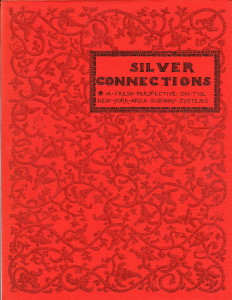
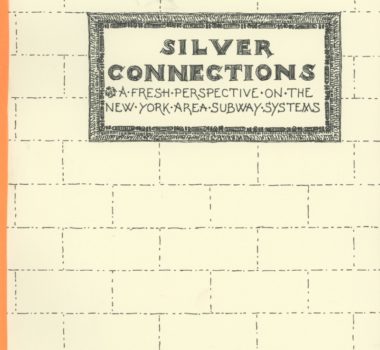
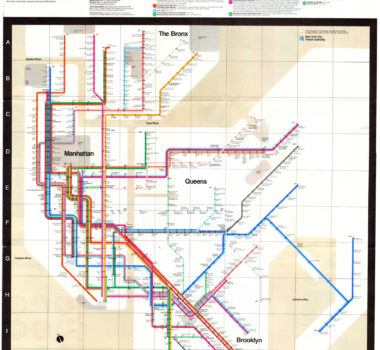
In 1978, Philip Copp intended to spend a month working on an article about the art in New York City subway stations that he hoped to sell to a magazine. Today, thirty-four years later, Copp, also known as Philip Ashforth Coppola, a nom de plume of sorts, has probably not spent a day during which he did not work on this “article,” now a multi-volume collection of books, some self-published in limited edition and some in manuscript form.
As he discovered the artistic riches displayed in each station, Copp was overcome by the need to record what all the engineers, architects, artisans, and artists had done, before their work faded and they were forgotten forever. The environment underground, vandalism, and, most of all, time is eating away at the intricate mosaic designs that adorn the walls of each and every station, and many are being replaced by plain white tiles that forever erase any trace of what was once there. Read the rest of this entry »
Tags: New York City history, NYC subway, Philip Ashforth Coppola, Silver Connections, subway art
New York Bound Books highly recommends a visit to see the exhibition, The Greatest Grid: The Master Plan of Manhattan, 1811-2011, at The Museum of the City of New York before it closes on July 15th. We also enthusiastically recommend the authoritative and handsome companion book to the exhibit, The Greatest Grid: The Master Plan of Manhattan, 1811-2011 edited by Hillary Ballon, the show’s curator, and published by the Museum of the City of New York and Columbia University Press.
New York’s City Hall officially opened in 1812, elegantly clad in marble, except for the rear of the building, which was finished in brown sandstone. This was the architects’ response to complaints of extravagance. City Hall was then situated at the northern end of the city, and Manhattan’s meteoric growth northward was not forseen.
New York’s Common Council (now called the City Council), however, had the foresight to appoint three commissioners to oversee the development of a rectangular grid of numbered streets and avenues that reached to 155th Street. The MCNY exhibition and book tell the story of this spectacular and ambitious plan as it unfolded over two centuries.
The Greatest Grid: The Master Plan of Manhattan, 1811-2011
at the Museum of the City of New York December 6, 2011 through July 15, 2012The Greatest Grid: The Master Plan of Manhattan, 1811-2011 edited by Hilary Ballon, published by the Museum of the City of New York and Columbia University Press, 2011.
Read The New York Times review of the exhibition here.
Read The Bowery Boys review of the exhibition and companion book here.
The Greatest Grid curator speaks about the Commissioners’ Plan of 1811:
Tags: Commissioner's Plan of 1811, Museum of the City of New York, New York City history, urban planning