New York City history

In October 1872, the first ship ever owned and managed for commercial purposes by women set sail from New York for Asia.  The clipper ship, called the Madame Demorest, that proudly sported a carved image of Nell Demorest as its figurehead and a flag advertising “The Woman’s Tea Company,” was seen off by a crowd of curious well wishers including bankers, merchants, and the press.  Ellen (Nell) Curtis Demorest and Susan A. King, who spearheaded the enterprise, had similar beginnings: they both grew up in small upstate towns where at a young age they were aspiring entrepreneurs and moved to New York City to start their own businesses—and both succeeded brilliantly.

Nell Curtis watched her maid cut a dress pattern out of a paper bag, developed the idea of selling dressmaking patterns and built it into an international empire of manufacturing, mail order, emporiums, and magazines.  She and her husband, William Jenning Demorest, both proactive social reformers, used their magazines as a platform to advocate progressive issues as well as to promote their products.  Author Matthew Hale Smith described the Demorests’ liberal politics in his book Sunshine and Shadow in New York:

When philanthropy was not as popular as now, and when respectable and intelligent colored girls could not find employment in establishments called fashionable, Madame Demorest welcomed them to her Broadway rooms, gave them the same wages, and a seat in the same work-room that was assigned to others.  At first, fashionable ladies flaunted out of the rooms, and announced that they would not patronize an establishment that employed negro girls.  But they were glad to come back, as they could not get their work done elsewhere. (page 470.)

Susan A. King made her fortune buying and selling real estate. One of her major deals was selling  land to Union Theological Seminary in New York, to which she also gave a financial gift.  Once she had amassed her fortune, King also turned her attention to philanthropy.

Demorest and King were members of Sorosis, a social club for professional women that was devoted to aiding indigent females achieve  financial independence through higher education and employment opportunities. They also founded The House of Mercy for Fallen Women, but they came to believe that instead of charities, it was more effective to offer poor women a chance to earn their own living.

Ever inventive, innovative, and indomitable, Demorest and King decided to set up a business to be run by women.  In 1871, King set off on an eighteen-month trip to San Francisco to make business connections for the venture and sailed on to Asia to learn first hand how tea was grown and processed.  King fearlessly traveled deep into China’s countryside to deal directly with the farmers and select the choicest leaves in the best growing areas.

For their enterprise, Demorest and King settled on importing fine tea from the East that would be sold nationwide by women. Selling tea, which was a very popular beverage, seemed a “ladylike” commodity in which to deal, and they were convinced that they could obtain a higher quality tea if they dealt directly with the growers than what was presently imported from the East.  The two raised a half a million dollars to back the enterprise, purchased an old clipper ship, fitted it to transport tea, renamed it “Madame Demorest” and hired an all female crew for the 1872 voyage that drew a large audience of well wishers.

The Woman’s Tea Company did well enough to recoup all of its expenses, but it was not a lasting enterprise.  It was no match for The Atlantic and Pacific Tea Company, a powerful operation that began importing tea in 1859 and by 1878 had seventy stores. One wonders what  Demorest and King might have achieved if they put all of their formidable abilities and energy into managing the Woman’s Tea Company themselves, instead of setting it up for others to run it.

Reading List

Drachman, Virginia G.  Enterprising Women.  250 Years of American Business. Chapel Hill, N.C: University of North Carolina Press, 2002.

Leuzzi, Linda.  A Matter of Style, Women in the Fashion Industry. Danbury, Ct.: Franklin Watts, 1996.

Ross, Ishbel. Crusades and Crinolines: The Life and Times of Ellen Curtis Demorest and William Jennings Demorest. New York: Harper & Row, 1963.
The book is replete with interesting information about the Demorests, their business and the estimable people with whom they interacted.
Smith, Matthew Hale. Sunshine and Shadow in New York. Hartford: J.B. Burr and Co., 1869.

Tags: , , , , ,

"Bushwick" A brochure published in 1946 by the Brooklyn Eagle

A March 8, 2012 New York Times article declares that, “As with SoHo, Chelsea and the Lower East Side before it, Bushwick is shaping up as the city’s next gallery district.”  This and other recent Titles articles with titles such as “The Vanguard Alights” and “Bushwick is Getting Some Wine Shops” indicate that Bushwick has come of age as a (not so) new New York hipster destination.

As I flipped through a booklet entitled “Bushwick,” published in 1946 as part of a series of six booklets for public school students about the history of Brooklyn townships, Bushwick has a long history dating back 300 years.  On August 1, 1638, the West India Company bought from the Indians the land that comprises the old town of Bushwick for “8 fathoms of duffels cloth, 8 fathoms of wampum, 12 kettles, 8 adzes, 8 axes, some knives, corals and awls.”  The town was chartered by Peter Stuyvesant in 1661 and named “Boswijck,” meaning “little town in the woods” in Dutch.

By the end of the Revolution, Bushwick consisted of three hamlets whose inhabitants were mostly farmers growing fruits and vegetables for the New York markets.  This farmland was coveted by real estate speculators who wanted to build a suburban development.

The Bushwick village square, no date (source: BUSHWICK bythe Brooklyn Eagle)

In 1868, the Long Island Railroad added a Bushwick Branch and in 1885, the Lexington Avenue elevated, the first elevated train in Brooklyn, terminated in Bushwick thus making the area accessible by public transportation.  At the same time, as the New York area began to industrialize, factories were built, including Peter Cooper’s first, a glue factory.  The area was also home to 44 breweries by 1904 due to a large influx of German immigrants, making it the “beer capital of the Northeast.”

During the 20th century, the area shifted demographics, first becoming one of the largest Italian-American communities and later in the century becoming predominantly African-American.  For a time, Bushwick was a very affluent area, with grand homes on grand boulevards, according to the nyc.gov website:

Bushwick homes were designed in the Italianate, Neo Greco, Romanesque Revival, and Queen Anne styles by well known architects. The New York City Landmarks Commission considered two sections worthy of Historic District Status in the 1970′s and described the corner of Bushwick Avenue and Lindens Street as “one of the finest groups of Romanesque Revival architecture in the City.”

Looting in Bushwick after the blackout of 1977 (photo: © Alon Reininger)

By the time of the New York City blackout in the summer of 1977, Bushwick had become an economically depressed area.  During the blackout, many of the area’s shop were looted and were forced to close permanently.  In addition, an arson fire three days after the blackout left 23 buildings destroyed over 7 blocks.

Since then, Bushwick has been slowly making a comeback, both residentially and commercially.  On his website “Up From Flames,” about the recovery of Bushwick, Adam Schwartz writes:

The events of July 1977, however apocalyptic they may have seemed, were also a turning point for Bushwick. The neighborhood had been suffering out of sight for many years.  After the jarring week of looting during the blackout and the “All Hands Fire”, the media came to Bushwick, and put it on the map. Through the city’s attention and the fire department’s innovative fire prevention program Bushwick was able to begin the process of regeneration.

After a long period of urban blight, Bushwick is once again transitioning, for better or worse.  Ironically, there is even a Bushwick Farmers Market, a project of Ecostation: NY, who has also developed Farm-in-the-Sky, a prototype rooftop farm that has brought farming back, after three centuries, to the hamlet of Bushwick.


“Bushwick,” Brookyn Eagle Historic and Beautiful Brooklyn Pamphlet Series
(Flatlands, Flatbush, Brooklyn, Bushwick, New Utrecht, Gravesend)

Tags: , ,

I recently finished reading Love, Fiercely, a wonderful new book by Jean Zimmerman, that is aptly subtitled “A Gilded  Age Romance,” as I instantly fell in love with its remarkable protagonists and their families.  Having focused, professionally and personally, on New York history for so many years, I was delighted to see a new book about Isaac Newton Phelps Stokes, the man behind The Iconography of Manhattan Island  and his wife, Edith Phelps Stokes, nee Minturn.  Newton Phelps Stokes’ six-volume oeuvre, arguably the most important body of work on New York City, is a sweeping graphic and historic documentation of the city’s heritage.  Edith Phelps Stokes spearheaded the establishment of kindergarten education and legal adoption procedures—neither of which existed in her time. Read the rest of this entry »

Tags: , , , , , ,

May 1 was moving day in New York CityMoving day, also known as “rent day,” was a crazy New York City tradition from its early years until as late as World War II.  Each year in the beginning of February, landlords would inform tenants of their new rent rates, which would go into effect at 9:00 AM on May 1 of that year.  If the tenants could not afford their new rents, they would have between February 1 and May 1 to find a new apartment and move.  In some years, up to a million households waited until the very last minute, perhaps to take advantage of their old rent rate for as long as possible, to move, causing chaos in the streets of New York. Read the rest of this entry »

Tags: , , ,

The Loew Bridge, Broadway & Fulton St. (source: NYPL)

In honor of National Women’s History Month (March) and National Poetry Month (April), as well as national hat day (January 15), I would like to celebrate a New York poem written by Mary Eliza Tucker about a bridge spanning Broadway that was built for one mad hatter and torn down for another.

At one time there was some debate over whether or not Mary Eliza Tucker was of mixed Caucasian and African-American ancestry, as her work was included in collections of African-American literature, perhaps because her name is similar to that of another poet. Indeed, in the link to the poem on the New York Public Library’s site below states that the poem was “[p]repared as part of The Digital Schomburg, a project providing electronic access to collections on the African Diaspora and Africa from The New York Public Library.”  It has since been established by Janet Gray, in her 1998 article in Representations, that Tucker was a white woman who lived for some time in the South before she worked in New York as a writer. Read the rest of this entry »

Tags: , , , , ,

For a general appreciation of where you are, it helps to know who came before you and what was done.  Especially if it helps you now.
—Philip Copp in “One Track Mind”

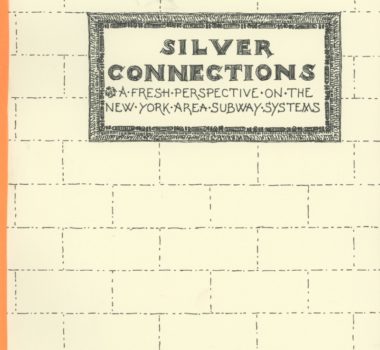
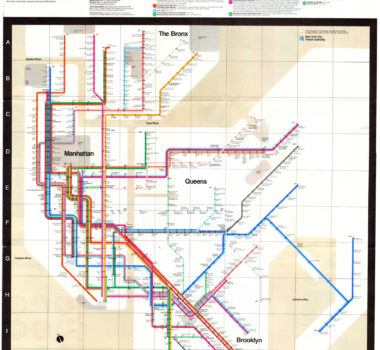
In 1978, Philip Copp intended to spend a month working on an article about the art in New York City subway stations that he hoped to sell to a magazine.  Today, thirty-four years later, Copp, also known as Philip Ashforth Coppola, a nom de plume of sorts, has probably not spent a day during which he did not work on this “article,” now a multi-volume collection of books, some self-published in limited edition and some in manuscript form.

As he discovered the artistic riches displayed in each station, Copp was overcome by the need to record what all the engineers, architects, artisans, and artists had done, before their work faded and they were forgotten forever.  The environment underground, vandalism, and, most of all, time is eating away at the intricate mosaic designs that adorn the walls of each and every station, and many are being replaced by plain white tiles that forever erase any trace of what was once there. Read the rest of this entry »

Tags: , , , ,

New York Bound Books highly recommends a visit to see the exhibition, The Greatest Grid: The Master Plan of Manhattan, 1811-2011, at The Museum of the City of New York before it closes on July 15th.  We also enthusiastically recommend the authoritative and handsome companion book to the exhibit, The Greatest Grid: The Master Plan of Manhattan, 1811-2011 edited by Hillary Ballon, the show’s curator, and published by the Museum of the City of New York and Columbia University Press.

New York’s City Hall officially opened in 1812, elegantly clad in marble, except for the rear of the building, which was finished in brown sandstone. This was  the architects’ response to complaints of extravagance.  City Hall was then situated at the northern end of the city, and  Manhattan’s meteoric growth northward was not forseen.

New York’s Common Council (now called the City Council), however, had the foresight to appoint three commissioners to oversee the development of a rectangular grid of numbered streets and avenues that reached to 155th Street.  The MCNY exhibition and book tell the story of this spectacular and ambitious plan as it unfolded over two centuries.


The Greatest Grid: The Master Plan of Manhattan, 1811-2011
at the Museum of the City of New York December 6, 2011 through July 15, 2012

The Greatest Grid: The Master Plan of Manhattan, 1811-2011 edited by Hilary Ballon, published by the Museum of the City of New York and Columbia University Press, 2011.


Read The New York Times review of the exhibition here.

Read The Bowery Boys review of the exhibition and companion book here.

The Greatest Grid curator speaks about the Commissioners’ Plan of 1811:

Tags: , , ,

Emma Lazarus (image: Wikipedia)

The name Emma Lazarus was probably unknown to most when, on October 28, 1886, throngs gathered to dedicate Liberty Enlightening the World, later to become known as The Statue of Liberty, France’s gift to the United States.  As we now celebrate the 125th anniversary of its dedication, Lazarus is known as the poet whose words grace the statue’s pedestal.  Her sonnet, “The New Colossus,” was written to raise money for the Statue’s Pedestal Fund (the U.S. was to provide the pedestal for the Statue), but it was not until 1903, sixteen years after her death, after the tireless lobbying of Lazarus’ friend, Georgina Schuyler, that her words were mounted on a bronze tablet inside the pedestal.  And it was not until decades after her words were put on display that the sonnet became widely known and associated with the Statue.

Lazarus’ background was likely a contributing factor in her semi-obscurity.  Although Lazarus was a fourth-generation American from a wealthy family who was mentored by Ralph Waldo Emerson, according to the Jewish Women’s Archive:

As a Jewish American woman, Emma Lazarus faced the challenge of belonging to two often conflicting worlds. As a woman she dealt with unequal treatment in both. The difficult experiences lent power and depth to her work. At the same time, her complicated identity has obscured her place in American culture.

The Statue of Liberty

The now famous lines, “Give me your tired, your poor/Your huddled masses yearning to breathe free,” were inspired by Lazarus’ frequent trips to Ward’s Island where many Jews who fled the pogroms in Eastern Europe were being held.  She was saddened by the plight of the Russian Jews she met at Castle Garden and unsuccessfully attempted to raise funds to benefit the refugees.  With her sonnet, she broadened her appeal to include all immigrants.  In a recent New York Times article, Sam Roberts quotes Professor Esther Schor, author of a biography of Lazarus, as saying, “the statue was a special kind of mother—a ‘mother of exiles’—a mother whose mission is not to reproduce herself, but rather to adopt the abandoned, the orphaned, the persecuted.” Read the rest of this entry »

Tags: , , , , ,

View of Wall Street, from the corner of Broad Street, 1850 (from The Historical Atlas of New York City)

Question:  I am writing a novel set in New York in the 1850’s.  Can you suggest books and other resources to use in my research?

The transformation of New York City during the first half of the nineteenth century was both rapid and dramatic.  A visitor to New York after the Revolutionary War would find a close-knit settlement at the southern tip of Manhattan rebounding from the devastating British occupation. A visitor returning in the 1850’s would discover a new metropolis comparable to London or Paris. The legendary heartbeat of the city was now palpable.

…the wharfs…are a scene of indescribable bustle from morning to night, with ships arriving and sailing, ships loading and unloading, and emigrants pouring into the town in an almost incessant stream…. (Isabella Byrd, 1854, in Mirror for Gotham, p. 159)

…Nothing and nobody seems to stand still for half a moment in New York, the multitudinous omnibuses which drive like insane vehicles from morning till night appear not to pause to take up their passengers…. (Travels in the U.S. during 1849 and 1850)

Here, was a quarter of a mile of ‘hardware’ warehouses; here, as great a length of ‘cassimeres and woolen good stores; here a few hundred yards of ‘straw-bonnet stores’; and there, a whole street devoted to ‘leather stores’ and leather findings.’  It seemed as if almost every kind of supply had its chief quarter in the city. … New York is not merely a “ commercial city” …she is largely engaged in manufactures of various kinds,—indeed more so than any other city in America.  (Mirror for Gotham, pp132-133) Read the rest of this entry »

Tags: , , , , , ,

New Books

Carpenter, Teresa, editor.  New York Diaries: 1609-2009.  New York, NY: Modern Library, 2012.
Carpenter weaves together diary entries, official records and notes from datebooks spanning 400 years into a rich, unorthodox, and very human history of New York City.


Chopra, Ruma.  Unnatural Rebellion: Loyalists in New York City during the Revolution. Charlottesville, VA: University of Virginia Press, 2011.
We recently discovered this excellent, thorough account of a subject not commonly addressed—Americans who were loyal to the Crown and stayed in British-controlled New York City during the war. It is a textured, perceptive study of the varied reasons for opposing the revolution and the loyalists’ ultimate disillusionment with the English government.


Davis, Marni. Jews and Booze: Becoming American in the Age of Prohibition. New York, NY:New York University Press, 2012.
Another round to our bibliography on Prohibition.  Despite the humorous title, this book is a serious exploration of Jews in the liquor business.  Before Prohibition, the trade in whiskey was a way for immigrants to integrate into the culture.  The Jewish community largely opposed and defied the ban and sold liquor on principle and because of its  ancient role in Jewish rituals, thus engendering ethnic stereotypes and anti-Semitism.


Steinberg, Nicole, Editor.  Forgotten Borough: Writers Come to Terms with Queens.  Albany, NY: State University of Albany Press, 2012.
Twenty-two emerging writers who lived in Queens are featured here—a rare literary nod to the oft overlooked borough.


Tags: , , , , ,

« Older entries § Newer entries »